

A soccer field and a football field might both be large rectangular grass surfaces, but they are far from the same thing. From the total size and shape to the markings painted on the surface, every detail is different.
Soccer fields are wider, more flexible in dimension, and built for a game that never stops moving. Football fields are narrower, precisely measured, and lined from end to end to track every yard of progress.
If you are watching from the stands or stepping onto the surface for the first time, these differences matter more than most people realize.
Let’s find out exactly how the two fields compare in size, layout, markings, goals, and real-world usage so you walk away with a clear, complete picture.
| Quick Answer: A soccer field and an American football field are not the same. Soccer fields are larger and vary in dimensions depending on the league. Football fields are fixed at 120 yards long and 53.3 yards wide, with yard lines and hash marks covering the entire surface. Each field is purpose-built for its sport, and the two are not interchangeable. |
Is a Soccer Field the Same as A Football Field?

No, a soccer field and a football field are not the same. Both are large rectangular playing surfaces, but they differ in size, markings, and structure.
Soccer fields are wider, allow more dimensional flexibility, and are marked with penalty areas, a center circle, and corner arcs.
Football fields are narrower, have fixed dimensions, and are marked with yard lines, hash marks, and end zones. Each field is purpose-built for its own sport, and the two cannot be used interchangeably without significant reconfiguration.
Soccer Field vs Football Field Comparison Table
Before getting into the details, here is a side-by-side breakdown of the most important differences between a soccer field and a football field in terms of size, markings, goals, and gameplay.
| Feature | Soccer Field | Football Field |
|---|---|---|
| Surface | Grass or turf | Grass or turf |
| Goals | Netted posts | H-shaped goalposts |
| Key markings | Center circle, penalty area, corner arcs | Yard lines, hash marks, end zones |
| Scoring zone | Goal mouth | 10-yard end zone |
| Governing body | FIFA | NFL / NCAA |
| Field variation | Allowed within the FIFA range | Fixed at all levels |
| Game flow | Continuous | Stop and start |
Soccer Field vs Football Field Dimensions

When it comes to size, the two fields are further apart than most people expect, and the numbers tell a very clear story.
Soccer field size
FIFA allows soccer fields to measure between 100 and 110 meters long and 64 to 75 meters wide for international matches.
For World Cup play, dimensions are tightened slightly for consistency. Most professional clubs use a field around 105 by 68 meters, though youth and recreational fields scale down significantly based on age group and competition level.
Football field size
An NFL football field measures exactly 120 yards long and 53 and one-third yards wide, including two 10-yard end zones.
These dimensions are fixed across all levels, from high school through college to the NFL, with only the hash mark placement varying between levels.
Which Field Is Bigger, Soccer or Football?
Soccer fields are bigger. A standard FIFA field at 105 by 68 meters covers roughly 7,140 square meters compared to around 5,351 square meters for an NFL field.
Soccer fields are also considerably wider, making the total surface area noticeably larger even at minimum FIFA dimensions.
| Dimension | Soccer Field (FIFA) | Football Field (NFL) |
|---|---|---|
| Length | 100 to 110 meters | 109.7 meters (120 yards) |
| Width | 64 to 75 meters | 48.8 meters (53.3 yards) |
| Total Area | Around 7,140 sq meters | Around 5,351 sq meters |
| End Zones | None | 2 x 10 yards each |
| Playing Area | Full field length | 100 yards between end zones |
| Dimensions Fixed | No, range allowed | Yes, fixed at all levels |
Field Layout and Markings

Both fields use markings in very different ways, and understanding what each line means helps explain how the two sports are structured from the ground up.
The timing structure in sports also affects flow, as in a soccer match.
Soccer Field Markings
Soccer field markings define boundaries, restart positions, and scoring zones.
Key markings include the center circle for kickoffs, the penalty area where fouls result in penalty kicks, the goal box for goalkeeper rules, and the corner arcs for corner-kick placement.
Every marking supports the continuous flow of the game without unnecessarily breaking play.
Football Field Markings
Football markings are designed to measure progress down the field.
Yard lines cross the full width every five yards, hash marks position the ball before each play, and end zone markings define where touchdowns are scored.
Numbers printed on the field help players and officials quickly identify positions during fast-moving plays.
Penalty Area vs End Zone
Two of the most important zones on each field serve completely different purposes, but both carry enormous weight in deciding the outcome of a game.
| Feature | Penalty Area | End Zone |
|---|---|---|
| Size | 40.3 x 16.5 meters | 10 yards deep, full width |
| Purpose | Triggers penalty kicks for fouls | Primary scoring territory |
| Defensive pressure | High, fouls are costly | High, the defending team protects it |
| Offensive goal | Create chances inside the box | Carry or catch the ball to score |
Yard Lines vs Center Circle
These two markings sit at the heart of how each sport controls positioning, restarts, and the overall flow of play.
| Feature | Yard Lines | Center Circle |
|---|---|---|
| Purpose | Measure field position and progress | Controls kickoff player spacing |
| Placement | Every 5 yards across the full width | Center of the field |
| Used for | Every single play | Kickoffs and post-goal restarts |
| Game impact | Determines strategy on every down | Sets up each half and restarts |
Goals, Surfaces, and Gameplay Differences
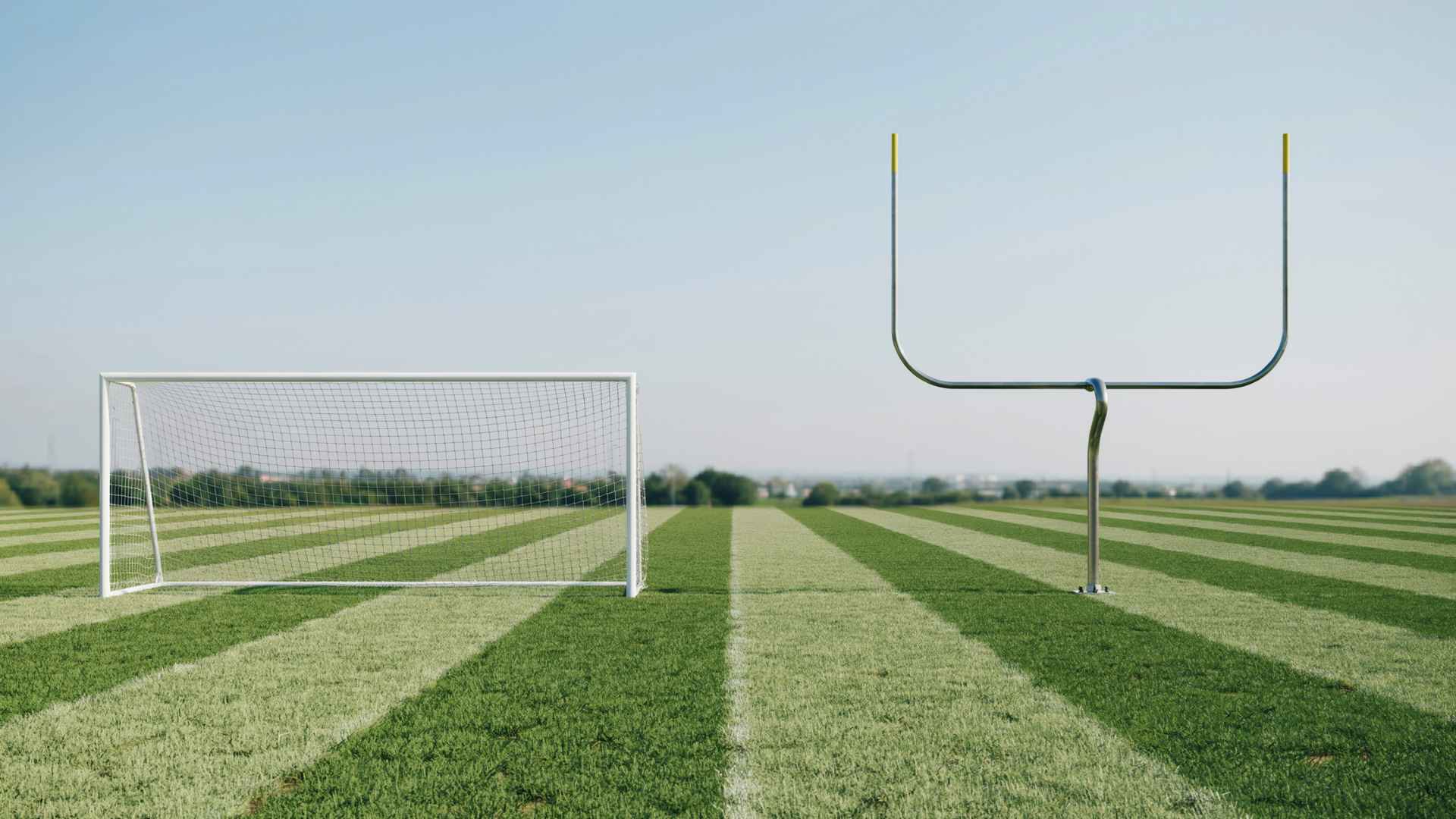
The equipment on each field is just as different as the surface itself, starting with the structures used for scoring.
Soccer Goals vs Football Goalposts
Soccer goals are large netted frames standing 2.44 meters tall and 7.32 meters wide, positioned flat along the goal line.
The ball must fully enter the net to score. Football goalposts are tall H-shaped structures that rise above the back of each end zone and are used for field goals, extra points, and two-point conversions.
Soccer goals reward ground-level attacking play while football goalposts reward precision kicking from distance.
Grass vs Artificial Turf
Surface choice plays a bigger role in both sports than most fans realize, and the preferences on each side tell a lot about how the game is played.
| Feature | Soccer | Football |
|---|---|---|
| Preferred surface | Natural grass | Grass or artificial turf |
| Turf usage | Common at lower levels | Widely used at all levels |
| Player preference | Mostly natural grass | Mixed across players |
| Surface impact | Affects ball roll and pace | Affects traction and player safety |
How Does Each Field Support the Sport’s Gameplay?
Soccer fields are wide and open to support constant movement, fluid passing, and attacking play across large areas.
The generous dimensions give players room to build play from the back, stretch defenses wide, and create scoring opportunities from multiple angles.
Football fields are compact and carefully marked to support a structured format in which every inch gained is tracked, and every play is reset from a fixed position.
The design of each field directly reflects the pace, rules, and strategy of the sport it was built for, ensuring players can perform at the highest level within the boundaries their game demands.
Can Soccer and Football Use the Same Field?

Both sports can technically share the same surface, but it takes more than swapping equipment.
Soccer can be played on a football field, though the width falls short of FIFA standards and temporary goals are required.
Football markings also create visual confusion during play.
Going the other direction, football can be played on a soccer field, but hash marks, end zones, and goalposts all need to be configured from scratch.
Shared stadiums like Gillette Stadium and Mercedes-Benz Stadium manage this through convertible turf systems and removable markings.
These differences become more noticeable when you compare how timing works in football structure versus open-field sports.
The real cost is surface quality. Frequent switching between sports puts heavy stress on the turf, raising concerns about field condition and player safety for both games.
Final Verdict: Soccer Field vs Football Field
After comparing size, markings, layout, goals, and shared use, the differences are clear.
Soccer fields are larger overall, with wider dimensions that give them a significant size advantage over football fields, even at minimum FIFA measurements.
Football fields carry more markings by far, with yard lines, hash marks, numbered indicators, end zone lettering, and boundary lines covering nearly every inch of the surface.
Soccer fields keep it minimal, using only the lines needed to support continuous play.
The two surfaces are built for completely different games and cannot be treated as interchangeable.
Understanding how each field is designed helps fans, coaches, and players appreciate the thought that goes into making every sport work at its best.
Frequently Asked Questions
Is a Soccer Field the Same as a Football Field?
No. The two fields look similar at first glance but differ in size, markings, goals, and overall structure.
How Much Bigger Is a Soccer Field than A Football Field?
A standard soccer field covers around 7,140 square meters compared to roughly 5,351 square meters for a football field, making it about 33 percent larger.
Why Are Soccer Fields Different Sizes?
FIFA allows a size range rather than fixed dimensions, giving clubs and venues flexibility while still meeting minimum standards for safe competitive play.