

From the coastal storms battering the Maritimes to the extreme cold in the Prairies and the growing wildfire threats in the West, power outages are a constant risk across Canada. For Canadian families, when the lights go out, preparation is not just smart, it’s essential for comfort and safety.
To build an effective emergency power plan, you need to go beyond just keeping a few basic supplies. You need to have provisions that will safeguard the home and family, as well as provisions that will ensure continuity in utility power. You need to ensure peace of mind, warmth, and connectivity.
This is a process that will take time, but we will help you figure out what the Jackery Explorer 5000 Plus, a dependable and clean energy source, is going to provide. You can put it as the primary component to build your family’s home emergency plan.
1. Risk Evaluation and Power Grids in Canada
Due to massive geography and shifting weather systems, Canada can experience weather outages that can be sudden, targeted, and long-lasting. In planning your Home & Emergency Backup, you must recognize and evaluate these local-level risks.
- Southern and Central Canada’s ice storms and heavy snowfall: These events can devastate communities, damaging power lines and infrastructure, and leaving grids vulnerable for long periods.
- BC and Alberta’s Wildfire–plus Heat: Scheduled power cuts can happen along with unexpected outages, and intense, prolonged heat waves can contribute to the brownout of grids, resulting in brownouts.
- Living in Rural areas: People living outside the major cities often experience detrimental effects, where power outages last days instead of hours. Energy dependence becomes a must.
A reliable home battery backup shifts your household from being reactive to outages to being fully prepared.
The Power Supply and the Shift: Absence of Fuel Dependency and the Use of Clean Power
Nowadays, the family-oriented household marketers are capable. They can go beyond red alert preparedness and instead focus on the balance of overall impact. Moving toward a clean solar generator for home use offers compelling dual benefits: security during an outage and a valuable tool for energy management that can potentially reduce your reliance on high-cost peak-hour grid electricity.
2. The Case Against Traditional Generators: Why Clean Energy Wins
For decades, the gas generator was the viable standard for backup power. However, their drawbacks—especially in the Canadian residential context—are considerable and limit their practicality:
| Issue | Traditional Gas Generator | Modern Solar Generator |
|---|---|---|
| Emissions & Safety | Produces toxic carbon monoxide (CO). Must be strictly used outdoors. | Zero emissions. Safe to operate indoors (garage, utility room, basement) without CO risk. |
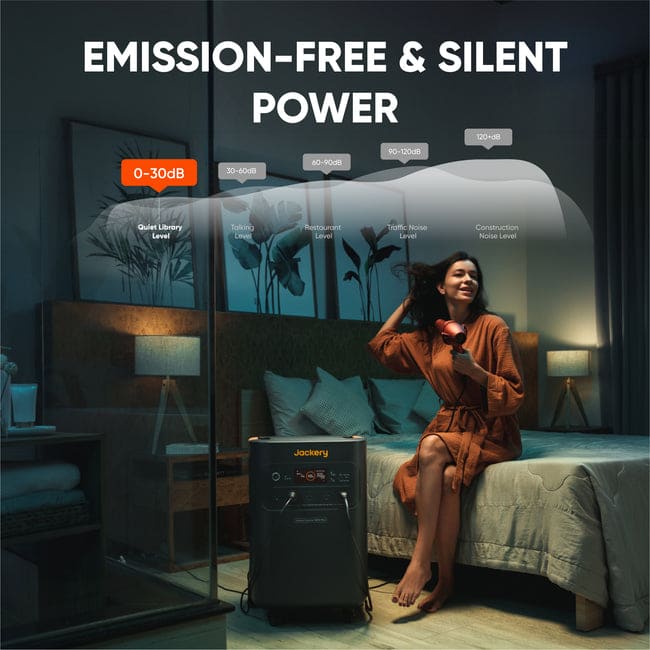
| Noise Pollution | Loud, disruptive, and a source of neighborhood complaint. | Whisper-quiet operation (typically 30 dB or less), preserving the peace of your home. |
| Fuel Logistics | Requires storing and handling flammable gasoline, which degrades over time. | Powered by solar energy (free and renewable) or a standard wall outlet. |
| Maintenance | Demands routine oil changes, filter checks, and testing to ensure reliable starting. | Requires zero routine maintenance. Always ready when you need it. |
| Power Quality | Output can be unstable, potentially damaging sensitive electronics. | Provides Pure Sine Wave output, ensuring safe power for most sensitive home office equipment. |
The transition from a traditional gas generator to a simplified home battery backup system reflects a necessary update to technology that aligns with contemporary safety, environmental, and residential living standards.
3. The Jackery Explorer 5000 Plus: Engineered for Canadian Capacity
Both “portable power station” and “home battery” share many characteristics with larger power systems, including capacity measured in kWh and output in watts, which determine how much power can be stored and delivered. For Canadian households, the system needs to be more durable and robust.
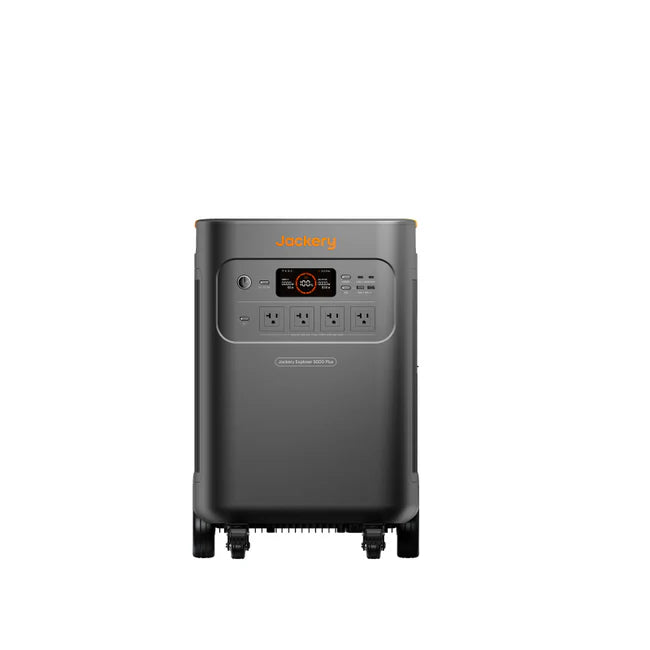
The Jackery Explorer 5000 Plus Portable Power Station is designed to meet these high demands, serving as the versatile and reliable core of your energy plan.
Core Specifications: Your Foundation of Backup Power
| Feature | Official Specification | Emergency Preparedness Benefit |
|---|---|---|
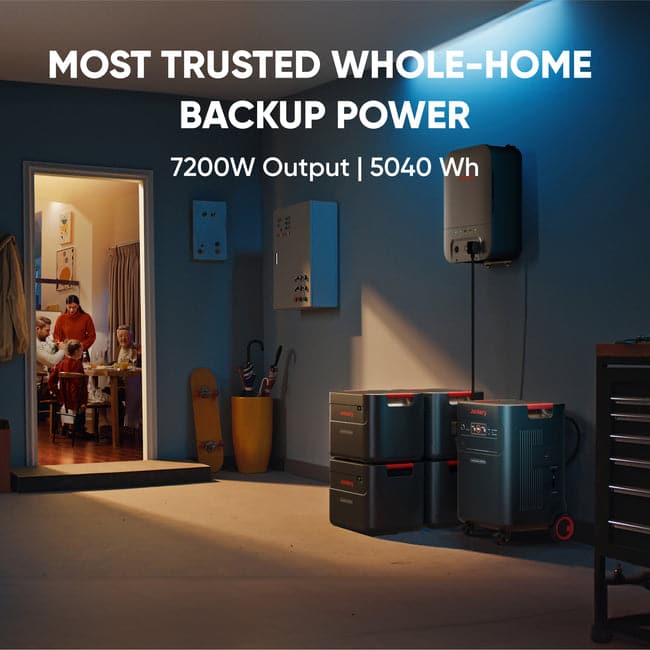
| Core Battery Capacity | 5 kWh (5040 Wh) | Sufficient energy to run critical, high-draw appliances (fridge, furnace fan). |
| Rated AC Output | 7.2 kW | Robust enough to handle the simultaneous running power of critical appliances, including well pumps and most household devices. |
| Maximum Expandability | Up to 30 kWh | Allows easy scaling by connecting additional Jackery Battery Packs. They can be expanded with up to 5 battery packs. |
| Maximum Solar Input | Up to 4 kW | Enables remarkably fast recharging from Jackery SolarSaga panels using sustainable solar power. |
| Battery Technology | LiFePO4 (Lithium Iron Phosphate) | Guarantees superior thermal stability, a longer life cycle (4000 cycles to 70% capacity), and enhanced overall safety. |
| Safety Certification | Meets required Canadian regulatory safety standards for use as a power station. |
Note: All data provided is sourced directly from Jackery’s official product specifications for the Canadian market.
4. Building Your Emergency Power Plan: A Strategic 4-Step Process
A successful emergency strategy is organized, realistic, and tailored to your family’s daily life.
Step 1: Identify and Prioritize Critical Loads
Your first action is to define the essential devices that must remain operational during a power outage. This list is the foundation for choosing the right capacity for your solar generator for house. Prioritize based on the following categories:
- Safety & Preservation: Refrigerator/Freezer (to protect food stores), security systems, and sump pumps or well pumps (critical for water access).
- Comfort & Health: The main furnace fan/blower ( critical for heat retention during a Canadian winter), CPAP machines, and essential lighting.
- Communication & Work: Wi-Fi router and modem (for emergency communication), and minimal charging hubs for phones and your home office laptop.
| Essential Canadian Appliance | Average Running Wattage | Usage Priority |
|---|---|---|
| Refrigerator (Standard) | 150 W | High (Food Preservation) |
| Gas/Oil Furnace Fan/Blower | 300 W | Critical (Winter Survival) |
| Well Pump (Intermittent) | 1,000 W | High (Water Access) |
| Wi-Fi Router & Modem | 20 W | Medium (Communication) |
| Home Office Laptop & Monitor | 150 W | Medium (Remote Work/News) |
Step 2: Calculate Your Total Daily Energy Needs (kWh)
To select the minimum required capacity for your home battery, estimate the total watt-hours (Wh) your critical items will consume over a 24-hour period.
Example Calculation for a 3-Day Backup Goal:
- Refrigerator (150W running for 10 hours/day) → 1,500 Wh
- Furnace Fan (300W running for 8 hours/day) → 2,400 Wh
- Lights & Router (70W running for 8 hours/day) → 560 Wh
- Total Daily Need ≈4,460 Wh (or 4.46 kWh)
Required Capacity for 3 Days: 4.46 kWh × 3 ≈13.38 kWh
This calculation shows that for sustained battery backup in regions prone to multi-day outages, you can scale the system up to 30 kWh using the optional battery packs.
Step 3: Verify Output Power (kW)
Always ensure the solar generator’s output capacity can handle two factors simultaneously:
- Surge/Starting Power: The brief, high-power spike required to start motors (like refrigerators or well pumps).
- Combined Running Power: The total sustained power draw of all devices running at the same time.
The Explorer 5000 Plus’s 7.2 kW continuous output is a high standard for a portable unit, providing ample current to manage these critical startup demands while keeping essential devices operational.
Step 4: Integrate the 4 kW Solar Charging System
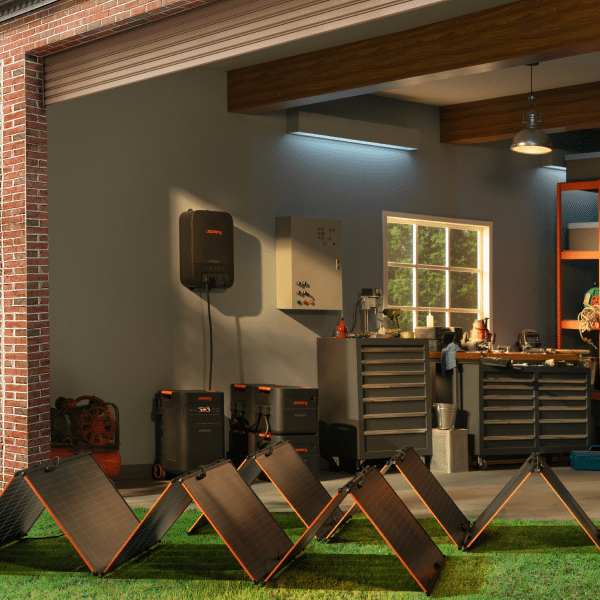
The best feature of a solar generator is that it recharges independently of the utility grid, providing a reliable source of backup power. With the combination of your Jackery Explorer 5000 Plus and Jackery SolarSaga(500X) panels, a continuous and sustainable power cycle is created.
- With a maximum solar input of 4kW, the system is optimized to capture solar power and replenish the 5kWh battery pack in 1.7 hours during peak sunlight.
- The perpetual use and replenish feature of the system makes it a reliable battery backup. Hence, it provides reliable energy independence until the grid is repaired.
5. Daily Benefits: Beyond Outages and Electric Bills
The investment in a high-capacity power station like the Explorer 5000 Plus delivers significant value even when your utility power is fully functional.
Smart Energy Optimization
Even though this technology will never replace your connection to the grid, it can still help minimize your electric bills. A scenario would be charging the home battery during off-peak hours overnight, at a lower charge, and then running specific appliances during the high-rate peak hours late in the afternoon. This technique succeeds in shifting energy use, resulting in stored solar power being utilized in the most efficient manner. The technique improves the overall energy strategy and reduces the use of energy during the most expensive peak times.
Portability and Versatility
The modular, easily moved design of the Explorer 5000 Plus means your home battery is not permanently fixed to one location:
- The Cottage or RV: Take one or two 5 kWh battery packs to the remote cabin or RV for clean, silent power, leaving the noisy traditional gas generator behind.
- The Workshop: Easily power high-draw tools in the garage or a detached shed without running extension cords back to the house.
- Outdoor Living: Provide quiet backup power for lighting and audio at outdoor gatherings, free from fumes and noise.
Frequently Asked Questions (FAQ)
1. How is the Jackery Explorer 5000 Plus different from a typical “home battery”?
Similar to the Jackery Explorer 5000 Plus, a solar generator for house is an integrated and portable home battery system. It consists of a battery, a charge controller, an inverter, and all other components needed, as well as the required ports, all contained in a single compact and modular device. Traditional “home batteries” often require a separate purchase and complex, permanent installation of additional components. The Jackery unit is an easily scalable, portable power station providing immediate battery backup.
2. Can the Jackery Explorer 5000 Plus run my furnace during a Canadian winter outage?
Yes indeed. The gas or oil furnace has a running power of about 300 W, attributed mainly to the blower fan. The 5 kWh capacity with 7.2 kW output can power the furnace along with the lights and refrigerator to keep the furnace critical to home heating and safety. The Explorer 5000 Plus is perfect for these critical loads.
3. Is the LiFePO4 battery suitable for extreme cold in Canada?
Lithium Iron Phosphate (LiFePO4) offers the highest thermal stability and reliability among common battery chemistries. All batteries operate less efficiently in extreme cold temperatures, but LiFePO4 batteries are generally the safest. As with all electronics of finesse, LiFePO4 batteries perform best when stored and operated in insulated environments. For charging, a centrally heated place such as a heated garage or basement will do the trick best. As a home battery backup system, we highly recommend such practice.
4. Can this solar generator truly provide multi-day power for a family?
Yes. The base 5 kWh unit provides 1 to 3 days of essential power. The modular expansion capability of up to 30 kWh, combined with the 4 kW solar input, creates a self-sustaining system. This configuration allows the system to be used continuously with the ability to recharge daily, providing battery backup to critical loads for weeks, which is well beyond the performance of basic systems.
5. Why is a solar generator for the home a better environmental choice than gas?
Using Jackery power stations outdoors means zero emissions and noise-free operation. Draw on solar power and back-up power not only stays within clean energy values but also does not require burning fossil fuels. This is the reason Jackery has earned the trust of environmentally conscious Canadian homeowners in search of a reliable gas-powered alternative.
Action: Power Your Canadian Home. Secure Your Family.
Creating a definitive emergency power plan with the right technology is the most important step you can take to protect your family from the disruption of power outages.
The Jackery Explorer 5000 Plus offers a clean, reliable, scalable, and noise-free home battery solution, moving your home beyond the limitations of the gas-powered alternative.
Explore how Jackery solar generator can help enhance your energy independence and provide peace of mind during power outages.