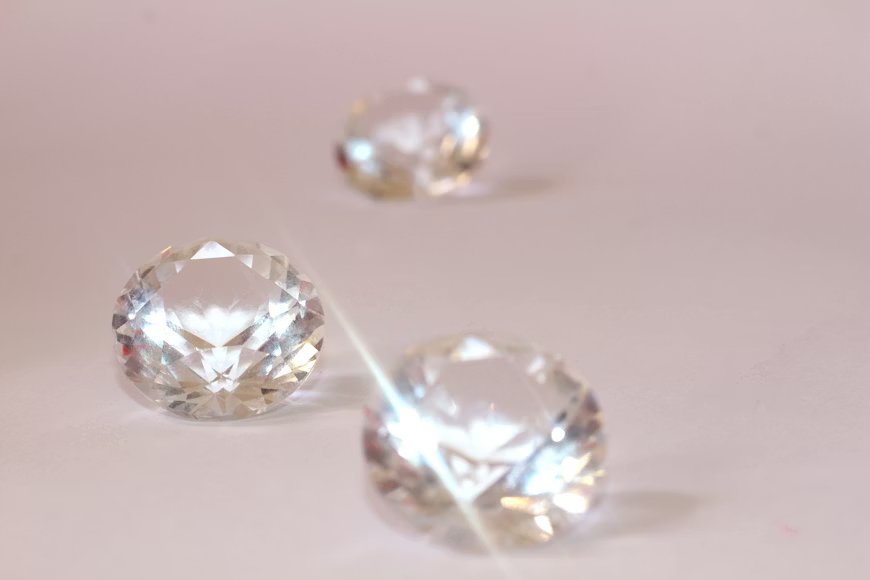

Have you ever wondered why a diamond can catch your eye from across a room? Well, this article will walk you through the exact reasons.
We’re going to look at how light behaves inside a diamond, how different cuts amplify sparkle, and why environmental factors can change the way a stone flashes. By the end, you’ll understand how they create that unmistakable burst of brilliance.
How Light Behaves Inside a Diamond
Diamonds do not simply reflect light off the surface. Instead, they bend it, slow it down, split it into colors, and bounce it around before sending it back out. The result is that glittery flash most people associate with a high-quality stone.
Refraction: The First Step to Sparkle
When light travels from air into a denser material, it slows down. That slowdown bends the ray, which is a process called refraction.
Diamonds bend light more strongly than most other gemstones because they have a high refractive index. This bend is strong enough to send the ray deep into the stone instead of letting it pass through easily.
The more time the light spends inside the diamond, the more opportunity it has to bounce around.
Total Internal Reflection: Light Trapped in a Glitter Loop
Once inside, light hits diamond facets at angles that often cause total internal reflection. This means the light ray rebounds instead of escaping. Over and over, light ricochets between facets until it eventually exits toward your eye.
A physics breakdown from U‑Learn explains that this is also why diamonds look dark or dull when cut incorrectly. If the facets do not guide the ray to bounce internally, the light leaks out the bottom.
Dispersion: Why You See Rainbow Flashes
The colorful flashes you see are caused by dispersion. When white light bends, each wavelength bends slightly differently. That creates the tiny rainbow streaks often called fire.
Diamonds produce stronger dispersion than many other clear gemstones. That is why even small stones can show vivid color bursts.
The Craftsmanship Behind Maximum Sparkle
Even a diamond with excellent natural properties will not look its best without the right cut. Cutting is where human skill sets the stage for optical magic.
How Precision‑Cut Facets Boost Brightness
Cutters shape diamonds so that their facets are angled with careful mathematical intention. When done correctly, the facets guide light into a predictable pattern of reflections, like tiny mirrors working in harmony.
This is why two diamonds of the same size and clarity can look completely different. One can sparkle intensely, while the other looks flat.
Why Not All Diamonds Sparkle Equally
Small shifts in facet angle make a big difference. Too shallow, and light escapes from the bottom. Too deep, and it leaks out the sides. Many modern workshops rely on optical modeling software to preview how a stone will handle light before making any cuts.
Here’s how different cutting proportions typically affect a diamond’s ability to sparkle:
- Ideal‑cut stones return the most light
- Deep‑cut stones often appear darker
- Shallow‑cut stones tend to look glassy with fewer flashes
A Real‑World Look at Craftsmanship and Diamond Culture
Craftsmanship shapes more than just how brightly a diamond sparkles. It also shapes the relationship people form with these stones, especially those who work with them every day.
One unusual story shows just how personal that connection can become. JCK profiled a Houston jeweler who, after losing an eye to complications from ocular toxoplasmosis, asked his ocularist to set a diamond into his prosthetic.
“It’s so comfortable,” the 24‑year‑old owner of Jones Jewelry & Co. in Houston tells JCK. “I sometimes forget I have it.”
The jeweler with the “Diamond Eye” is an example that highlights how craftsmanship can transform a diamond into something that carries story, identity, and a bit of glittering physics.
What Environment Does to the Sparkle
Even the brightest stones depend on their surroundings to shine well. A perfectly cut diamond under weak lighting simply cannot show its full energy.
Lighting Conditions That Boost Sparkle
Different kinds of lighting change what part of the diamond you notice most. Direct spotlights emphasize fire, while diffused daylight highlights the broader flashes known as brilliance.
Why Diamonds Look Brighter in Some Places Than Others
Diamonds love contrast and movement. A stone sitting still under soft indoor lighting might appear calm and understated. But the moment someone moves their hand or steps into direct sunlight, the flashing begins.
That motion bends reflections toward the eye in constantly shifting bursts.
Everyday Factors That Influence Sparkle
Two stones with the same cut can still look different depending on how often they are cleaned or how they are worn. Lotion, soap residue, and dust create a film that blocks incoming light and reduces sparkle. Even fingerprints weaken the bright flashes.
How Diamond‑Cut Styles Shape the Look of Sparkle
Not all diamonds are cut for the same effect. Some shapes emphasize sparkle, while others create broader flashes or softer glows.
Brilliant Cuts
Round brilliant cuts are engineered with dozens of small facets that optimize internal reflection. They produce the most recognizable sparkle pattern and are the most light‑efficient design.
Step Cuts
Emerald and Asscher cuts favor long facets that create slow, elegant flashes instead of glittery twinkles. They are prized for clarity and symmetry rather than intense fire.

Why People Are Drawn to Sparkly Stones
Humans have always been fascinated by light. Psychologists often point out that the eye is naturally drawn to sharp contrast and bright flashes. Diamonds combine both effects by bouncing light in rapid, attention‑grabbing ways.
Cultural Value and the Promise of Light
Diamonds have long symbolized resilience, clarity, and permanence. Their optical properties reinforce that symbolism each time the stone catches the light.
Bringing the Sparkle Into Focus
Diamonds sparkle because of physics, geometry, and the work of people who understand how stone and light interact. Whether in a ring, a pendant, or a surprising place like a prosthetic eye, diamonds continue to captivate because they turn light into something extraordinary.
Check out more of our blog posts to find out more about the fascinating world of sparkling diamonds.