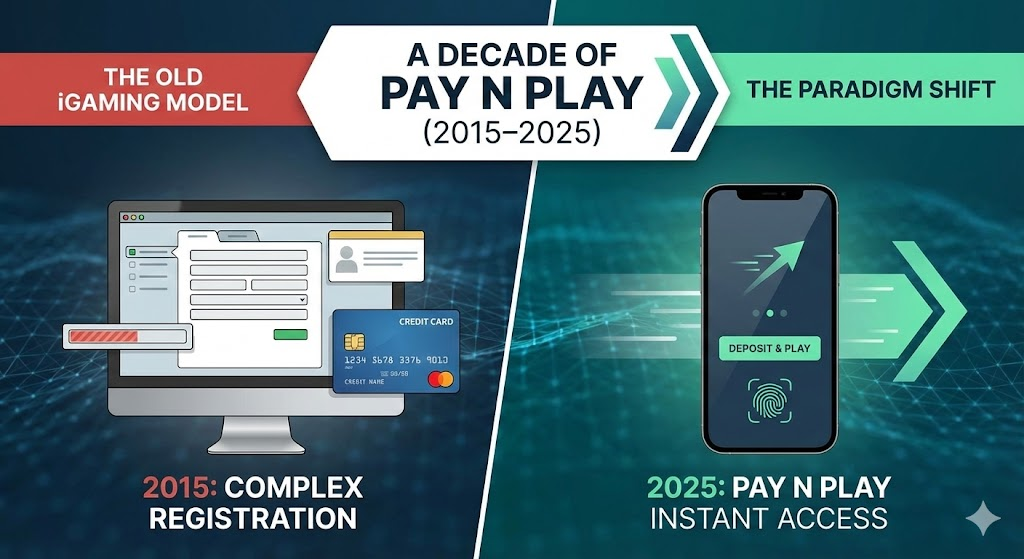

The online gambling marketplace has always been characterized by a major conflict: the necessity of strict regulatory adherence and the wish to attract the consumer with ease. Long registration forms and a complicated method of verifying identity were the industry standard over the years, with large player acquisition funnels having a massive drop-off rate. Nevertheless, a structural revolution took place in 2015, under the label of the Pay N Play (PnP) model.
Pay N Play, pioneered by Swedish fintech unicorn Trustly, radically re-invented the process of player onboarding. PnP has done away with the traditional registration form by integrating the processing of financial transactions and identity verification in a single and synchronous transaction. This was not only a convenience-based innovation, but a complex combination of Open Banking infrastructure, the Second Payment Services Directive (PSD2), and anti-money laundering (AML) regulations.
As we exit 2025, the industry is experiencing the next stage of maturation with the launch of Pay N Play 2.0. This paper is a comprehensive study of the ecosystem that breaks down the architecture of No Account, the working models, and the regulatory headwinds remaking the industry.
The Mechanics of “No Account” Gaming: Shadow Accounts and Open Banking
The No Account Casino is a misnomer in marketing that hides the sophisticated data architecture that is running under the user interface. As a matter of fact, Pay N Play casinos are based on the highly complex backend systems that generate and sustain persistent player records, also known as shadow accounts, without involving the user’s input.
The Open Banking Backbone
The effectiveness of the Pay N Play model will be dependent on the Open Banking infrastructure. This in the European Union is regulated by PSD2, which requires banks to grant access to consumer financial data to Third-Party Providers (TPPs) upon consent. As an Account Information Service Provider (AISP) and a Payment Initiation Service Provider (PISP), Trustly provides a twofold workflow:
- Payment Initiation: This allows a direct credit transfer between the bank of the user and the operator, avoiding the use of card networks and removing the risks of chargeback.
- Data Extraction: At the same time retrieves authenticated Know Your Customer (KYC) information, including name, date of birth, and national identification number, from the bank.
The “Shadow Account” Architecture
Although the user feels that they are playing without an account, the regulatory requirements are that the operators should have a complete customer record. Upon verifying the first deposit, the shadow account is made. The system creates a user ID that is based on unchangeable bank information (a hash of the national ID and IBAN).
This is the key that provides persistence. In case a player leaves his or her browser in a good balance, the money is secure. On coming back and authenticating themselves with their bank, the system compares the credentials with the shadow database and recovers the balance of the previous session. This architecture will provide strong audit trails and will enable operators to track responsible gambling behavior over multiple sessions, which is their duty of care, despite a frictionless environment.
Operational Models: Pure vs. Hybrid Deployments
Pay N Play is implemented depending on strategic objectives and the regulatory environment. In general, the industry can be divided into two major operational models, namely Pure and Hybrid.
The Pure Pay N Play Model
The Pure model Pay N Play is the registration and payment method only. Sign-up buttons have been removed, and an action button of either Deposit or Play Now is displayed prominently on the interface.
- User Experience: Authentication is done through BankID. The withdrawals are automated and immediate, and frequently, the money is transferred to the bank account of the player within a span of five minutes.
- Trade-offs: Although this model has the best conversion rates (zero friction), it has restricted the market to players who use the supported bank accounts, leaving behind those who use credit cards or e-wallets.
The Hybrid Pay N Play Model
The hybrid model combines PnP with the conventional registration flows. It is typical of the established brands that are updating their offering without draining out the current users.
- User Experience: Different sign-up and pay N Play entry points.
- Complexity: Backend logic has to be handled by the operators to avoid duplicate accounts (e.g., merging a manual email registration with a BankID deposit), and more frequently will lead to a slower withdrawal process after AML checks in various payment systems.
Innovation: In-Banner Pay N Play
One of the disruptive innovations that is on the rise is In-Banner Pay N Play. This enables clients to log in and save an advertisement banner on an affiliate site hosted by a third party. The authentication process, via a marketing touchpoint, can be drastically reduced in length, allowing an operator to transform a sports news reader into a funded player without needing to redirect to a landing page.
The Regulatory Landscape: Navigating Compliance
Pay N Play is a concept that is determined strictly by the national regulations. What works well in the Nordics might not work well in other places.
The Nordic Heartland (Sweden & Finland)
The home market in PnP is the mature Sweden. In 2019, it was re-regulated, where all gambling transactions were required to use BankID, and thus every licensed casino in Sweden became Pay N Play. The same ecosystem is found in Finland, but legislative changes are problematic when it comes to offshore PnP providers, as the nation abandons its monopoly framework to adopt the licensing framework.
The DACH Region (Germany)
Germany is a complicated business environment. There are relatively stringent restrictions, such as a limit of the deposit amount of €1,000 per month in all providers, provided under the terms of the Interstate Treaty on Gambling (GlueNeuRStV). The PnP operators will have to interrogate the central database (LUGAS) to verify compliance. This introduced delay, coupled with the severe policy of preventing payment to unlicensed sites, has made Germany a hard implementation location with regard to the instant promise of PnP.
The Netherlands: Launchpad for PnP 2.0
The Pure PnP model was originally incompatible with the Dutch Remote Gambling Act(KOA) in that it required verification of pre-deposit against the Cruks exclusion register. Trustly responded by creating Pay N Play 2.0. This customized flow serves the required verification on the bank authentication procedure, and keeps a sufficient onboarding time of about three minutes. The Netherlands has successfully turned into an experiment of compliance-first PnP and has transformed the value proposition of anonymity to hyper-efficient compliance.
Security, Fraud, and Liability
Pay N Play offers different vectors of security due to seamlessness. The model is dependent on the safety of bank credentials by eliminating manual verifications.
The BankID Fraud Vector
The sector has been affected by the development of vishing (voice phishing). Scammers deceive their victims into validating a login on a BankID, after which a casino account is accessed. Although in the past banks used to make users liable, the recent decisions made by the Swedish Supreme Court have reversed the responsibility, and banks have to reverse unauthorized transactions unless they can prove extreme failure in their duty. This has contributed to the introduction of a “Transaction Signing” in which a user has to view the exact name of the beneficiary (e.g., the name of the LeoVegas Casino) in their BankID app before making a transfer.
Duty of Care
In 2024, legal precedents were used to declare that the operators could not defend themselves with a No Account model by claiming that they were unaware of what the players would do. Shadow accounts contain a legal record. It, therefore, requires problem gambling markers to be analyzed by PnP operators. New engines, such as Trustly Azura engines, offer affordability signals at the point of deposit, which operators can act on before taking which transactions, and as such, fulfil their duty of care.
Global Frontiers and Future Outlook
Although Trustly still occupies a leading position in the market with a processing volume of more than 100 billion annually, it is a competitive market. Competitors such as Zimpler and Brite are struggling to share the market. Brite, an enterprise created by the former Trustly executives, uses its Instant Payments Network to provide a faster service in certain corridors, whereas Zimpler has been able to use the court to justify its right to offer verification solutions.
The next battlefield is North America. Although the US does not have a ubiquitous digital ID that is comparable to BankID, the implementation of FedNow (instant payment rails) and open banking regulations (Dodd-Frank Section 1033) is creating the foundation. The current implementations in the US are based on light registration with bank authentication, and the trend is obvious.
Conclusion: The Future of Frictionless Gaming
Pay N Play has developed into the gold standard of high-conversion iGaming in a niche Nordic novelty. It has addressed the two perennial sources of agony in the industry: registration friction and slow withdrawals. Pay N Play 2.0 can trigger a new phase in which the model will not be anonymous anymore, but rather, hyper-efficient compliance. The PnP providers are separating banking data into automated affordability checks and AML checks, making them the mainstay of the compliance infrastructure of the modern digital casino.
With the increasing demand for fast and safe transactions, it will be important to find the proper platform. Fast Pay N Play casinos recommended by Casinofy provide a guided approach to safe gambling to the players who are interested in these streamlined experiences. When seeking these gamer-friendly spaces, Casinofy is the place to begin. Casinofy is a top resource and review site of everything online casinos. They are informative, safe, reliable, and well-researched reviews about casinos, casino games, and the gambling industry in general. They use their knowledge and competency to give detailed and impartial assessments on anything related to gambling to their guests.