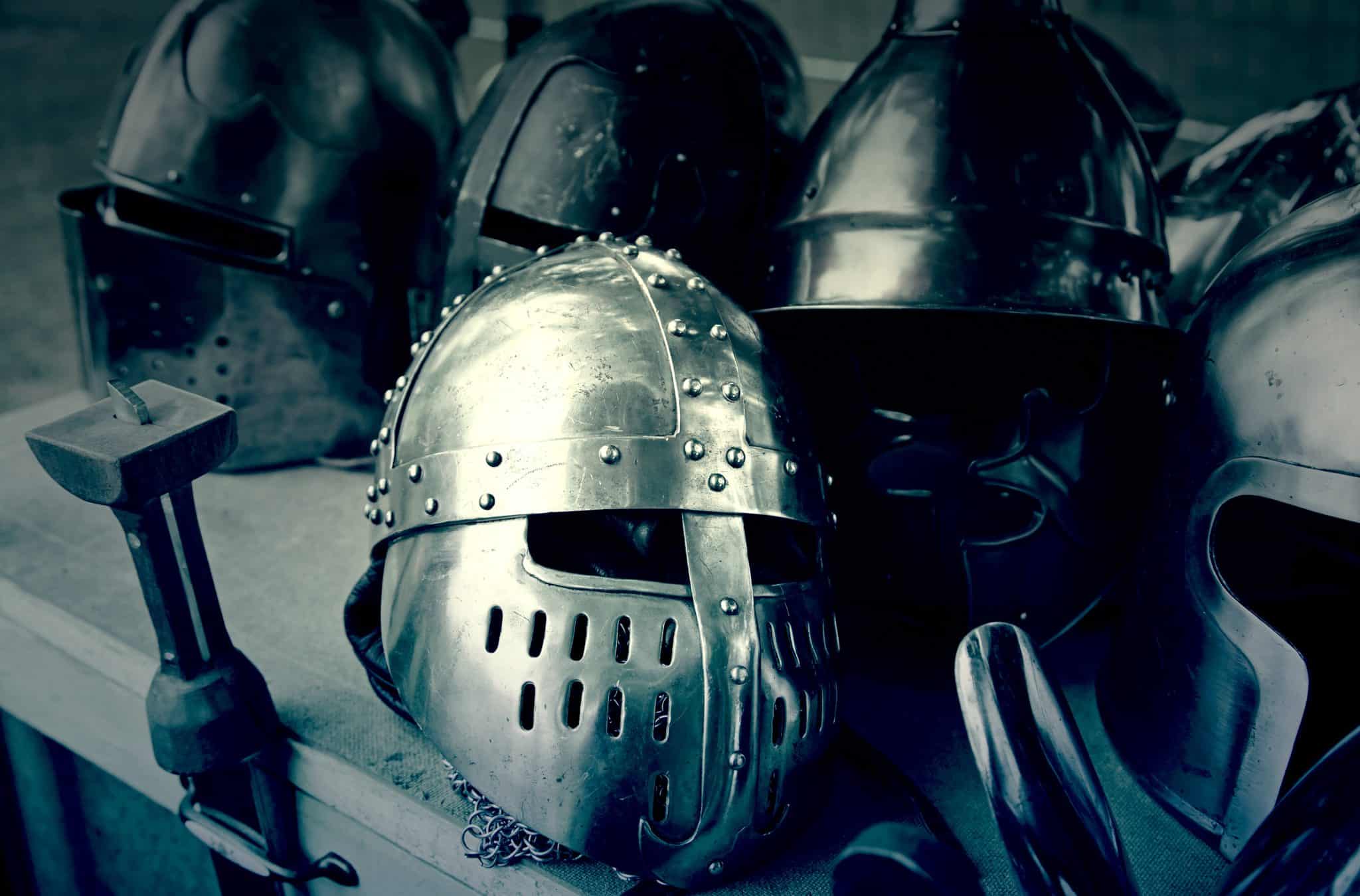

The buhurt helmets selection implies the most important single armor component that influences injury outcomes because it has simultaneous control over impact deceleration, rotational stability, oxygen intake, and visual awareness. Medieval Extreme produces helmets with measurable parameters such as steel thickness distribution, shell mass, liner compression depth, and fit geometry that come from head and torso measurements. It allows the fighters to make their choice of protection based on data rather than just the look.
Why Helmet Choice Is the Number One Safety Decision
A buhurt helmet has to cope with the forces of repeated strikes that sometimes go over several hundred joules of kinetic energy per impact. In contrast to limb armor, helmets must defend against direct and sideways motions, which are the leading causes of concussion.
Medieval Extreme tournament helmets indicate the gradients of the steel thickness rather than uniform shells. The bascinet helmets, which are very commonly used, are made with:
- 3.0 mm hardened steel at the top
- 2.0 mm hardened steel for the visor and lower shell areas
The distribution of the thickness dictates that the armor is strong enough to withstand the highest impact while at the same time the unnecessary mass in the lower sections is reduced to limit neck fatigue. The typical weight of the helmet for these configurations lies between 7.5 kg and 8.5 kg and is defined by the size and the configuration of the aventail.
If a helmet is chosen without any documented thickness or weight data, it offers uncontrolled variables into the safety of the head. A difference of even 1.0 kg at head level will greatly increase the load on the cervical spine during repeated impacts and in clinch situations.
Impact Basics: Shell, Liner, Suspension, Padding
The impact mitigation process of a buhurt helmet is constituted of four different layers that can be measured and that are working together.
- Outer shell. The outermost layer of the helmet is made of hardened steel which has been measured and documented in terms of its thickness values. A dome thickness of 3.0 mm prolongs the time of elastic deformation while the impact, hence it reduces the transmission of the peak force.
- Internal liner. The internal padding made of closed cell foam typically has a thickness of 10 mm and 20 mm depending on the size of the helmet. This provides a controlled deceleration distance for the skull before it touches the shell of the helmet.
- Suspension and retention system. The dual chin straps combined with a Simon strap attachment to body armor that reduces the rotation of the helmet are part of the suspension system. If the tension of the straps is proper, then the rotational slip under load will be just a few millimeters.
- Aventail integration. The neck protection that chainmail or plate aventails provide also helps in keeping the helmet stable in position during blows from above.
In cases where there is not enough thickness of the liner or the suspension is not secure, the impact energy is directly transmitted to the skull no matter how thick the shell is. Hence, the safety of the helmet is a problem of the system, not a question of choosing a single material.
Vision and Awareness: Safety Beyond Thickness
Injuries become more likely due to direct effects of vision limitations. A fighter who cannot see the strikes coming has to rely on reactive movements instead of anticipating, thus, the chances of getting the head hit are higher.
Medieval Extreme tournament helmets provide a way to see while being protected by employing reinforcement for the visor bars and using the eye openings to calculate the visibility. Usual examples permit:
- Horizontal vision width enough to have peripheral awareness
- Downward vision angles required for clinch and grapple situations
- Bar spacing designed to keep weapons out while allowing airflow
Vision apertures are placed to keep the helmet strong while not giving the tunnel vision effect found in helmets that are too restrictive. With less need to reposition the head, there is a corresponding reduction in exposure to unanticipated impacts.
Ventilation, Fog, and Fatigue in Long Rounds
Safety during multi-round buhurt fights is greatly affected by thermal and respiratory stress. Helmet ventilation has a direct impact on the availability of oxygen and the cognitive performance of the fighter. The primary factors that can be measured are:
- The internal air volume depending on the height of the helmet and the thickness of the liner,
- The position of the vent that enables passive airflow without endangering the integrity of the steel,
- The airflow from the aventail in the neck area,
Poor ventilation leads to increased internal humidity, fogging and quicker fatigue. Fatigue causes slowing of reaction and absorption of strikes has become more frequent. The positive effects from even very little improvements in airflow can be perceived as a reduction in exertion during longer rounds.
Fit Protocol: Measuring, Testing, Adjusting
The performance of a helmet relies on its fitting precision. Medieval Extreme does not rely on size ranges, but on individual measurements. The necessary measurements are:
- Maximum head circumference horizontally at the widest point
- Vertical distance from eye to shoulder to establish helmet height and internal geometry
- Neck circumference for integration of aventail and alignment of strap
Incorrectly sized helmets will allow the head to move freely inside the helmet, which will result in more rotational acceleration on impact. Even a 10 mm gap between head and liner increases the risk of concussion due to delayed deceleration.
The compression of liners and tension of straps have to be tested under movement and simulated impact conditions after the production to make sure the helmet is stable.
Practical Safety Decision Point
If the precise steel thickness, helmet weight, liner depth, and measurement protocol for a helmet cannot be recognized, then a safety decision is made without data. Prior to the selection of any buhurt helmet, please check:
- Dome thickness in mm
- Total helmet weight in kg
- Head and body measurements required
- Retention system design
Medieval Extreme shares these specifications with the community so that fighters can assess protection objectively instead of relying on assumptions. Before going up the list, make the documented measurements and specs your reference point.