

You probably remember the exact moment your “normal” school day shifted from walking across campus to rolling over and opening your laptop. One day you were trying to make it to an 8 a.m. in person; the next, your commute was three steps from your bed, and your classroom was a tiny square on a screen.
The routine you knew suddenly turned into a schedule built around links, codes and Wi-Fi strength.
Behind that shift, information technology service firms quietly became part of your academic background noise, even if you never thought about them. They helped keep learning platforms online and held together the stack of apps your classes rely on.
From Lecture Halls to Laptop Screens
Let’s start with the obvious: your day looks different now. “Going to class” might mean sitting at your kitchen table in sweatpants, headphones in, fingers crossed that your connection holds. The campus map on your phone matters less than the calendar app that tells you which link you’re supposed to click at 10:15.
You build your schedule around windows of time, not buildings. Maybe you squeeze a prerecorded lecture in before work or watch it later at 1.5x speed because you have a lab, a shift and a club meeting all in the same afternoon. You might hop between a Zoom lecture, an online quiz and a group chat about a project, all without leaving your chair.
That freedom feels good… until you realize that when class is always available, it can feel like you’re never really done. There’s always another video to watch, another module to open, another notification reminding you about a quiz that closes at midnight.
Your laptop becomes your classroom, your notebook and your to-do list, all arguing for attention at the same time.
Muted Mics, Open Chats
Remember when chatting in class meant whispering to the person sitting next to you and hoping the professor didn’t notice? Now you can talk to classmates while the professor is mid-sentence, and they will never know. Group chats, Discord servers and side conversations in meeting chats turned into the new back row of the lecture hall.
You’ve probably seen it: someone drops the link to the slides, someone else shares a meme about the assignment, and suddenly the chat is more alive than the actual discussion. Breakout rooms can feel awkward at first (everyone staring at one another, waiting for someone to talk) but they’ve also helped you meet people you never would have sat next to on campus.
At the same time, muting your mic is a lot easier than raising your hand in a crowded room. Leaving a call takes one click. It’s tempting to slip out early, skip asking a question or just watch the recording later.
Tabs, Timers and Tired Eyes
If your laptop could talk, it would probably ask you to slow down. Remote classrooms turned multitasking into a full-time sport. You might have a lecture in one tab, a reading in another and a “quick” video queued up as a reward you promise yourself for getting through the next slide.
The trouble is that those “quick” breaks can stretch. One short video becomes three. A glance at social media turns into 20 minutes. Your attention keeps bouncing between windows.
That constant switching wears you out in ways a long walk across campus never did:
- your eyes hurt
- your shoulders ache
- your brain feels foggy
What used to be a change of scenery (leaving one classroom and heading to another) now means closing one tab and opening a new one. You finish the day wondering how you can feel so tired after barely moving.
The Upside of Online Friendships
It’s easy to complain about remote classes, but they did create some surprisingly strong connections. Maybe your lab group survived the semester mostly through memes and late-night messages, and now you grab coffee in person whenever you can.
Online tools gave you more ways to stay in touch with people whose schedules would have made that impossible before. If you work nights or commute from off campus, you can still join study sessions, club meetings and group projects without racing to a building across town. That kind of flexibility matters when you’re juggling classes, work, family and whatever else your life throws at you.
There’s also comfort in knowing you’re not the only one scrambling. Seeing classmates post about a tough assignment, a weird deadline or a confusing lecture reminds you that everyone is figuring it out in real time.
The New Meaning of “Taking a Break”
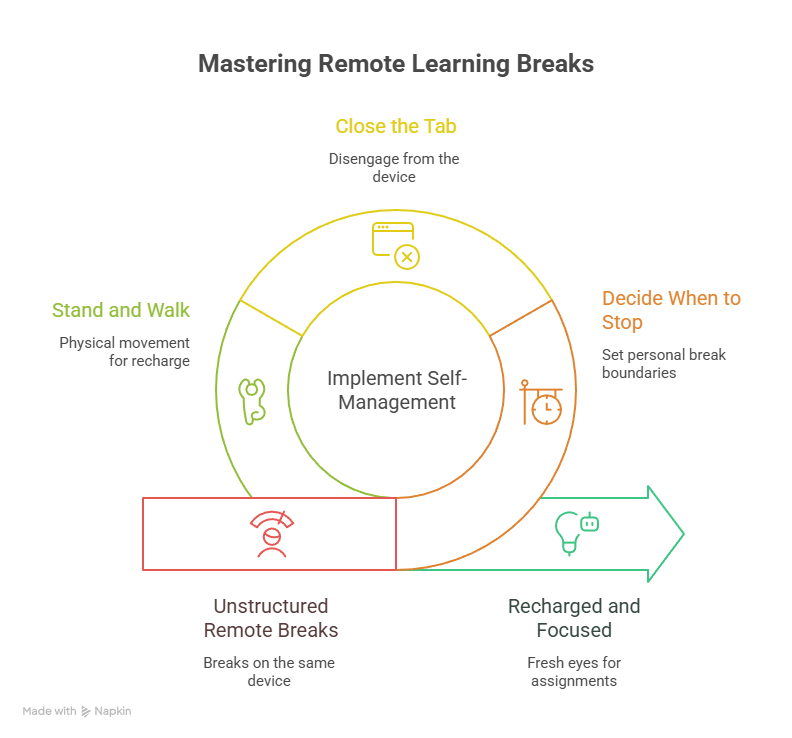
Before remote classrooms, taking a break meant walking outside, grabbing a snack or finding a bench between buildings. Now, your break often happens on the exact same device you use for class. You might switch from a lecture to a game, from a reading to a show, from a quiz to a friend’s messages.
When you use that time well, those microbreaks help you recharge. A short video or a quick scroll can reset your brain so you can come back to your assignment with fresh eyes. The key is deciding when to stop. There’s no bell, no professor packing up, no room emptying out to signal that it’s time to move on.
So, you end up becoming the one who sets the rules. You decide when to close the tab, put the phone down, stand up and walk around. That kind of self-management is a new skill that you learned by discovering your limit.
Learning To Draw Your Own Line
Remote classrooms didn’t just change where you learn; they changed how much control you have over your day. You pick the time you watch the lecture, the place you sit, the order you tackle your assignments.
That flexibility is powerful, but it also means you’re the one in charge of drawing the line between school and everything else.