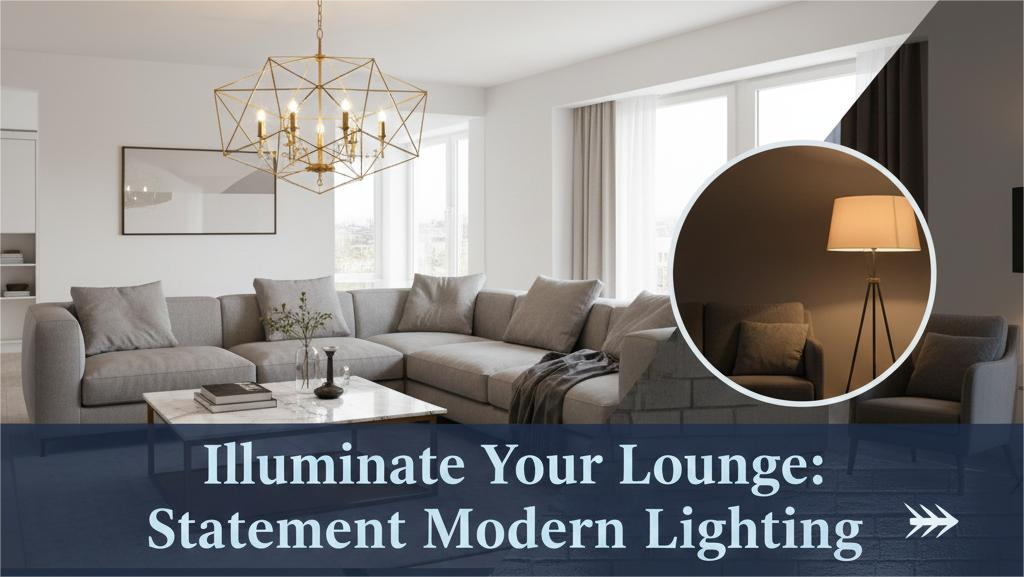

Let me guess. You’ve got that standard ceiling fixture that came with your house. It does the job, sure. But when you scroll through design Instagram or flip through home magazines, those living rooms have something yours doesn’t. That one statement piece that pulls everything together.
That missing piece? It’s probably a show-stopping overhead fixture.
I’m not talking about your grandmother’s crystal monstrosity or some dusty relic from a Victorian manor. Today’s statement lighting is sleek, sculptural, and surprisingly versatile. It works in minimalist lofts, cozy family rooms, and everything in between. The right piece doesn’t just light up your space. It completely transforms how the room feels.
Here’s what most people get wrong: they think dramatic overhead fixtures are only for formal dining rooms or grand entryways. That outdated thinking means living rooms get stuck with boring flush mounts or recessed cans that do nothing for the ambiance. Your living room is where life actually happens. It deserves lighting that matches that energy.
This guide walks you through everything you need to know about choosing statement lighting that works for your space, your style, and your budget. No fluff, no overwhelm. Just practical advice you can use this weekend.
What Actually Makes Overhead Lighting “Modern”?
The word “modern” gets thrown around a lot in home design, but what does it really mean when we’re talking about statement fixtures?
Contemporary overhead lighting strips away the fussy details. Forget about dozens of dangling crystals or ornate scrollwork. Instead, you’ll find clean lines, geometric shapes, and intentional negative space. Materials lean toward matte black metal, brushed brass, natural wood, or even concrete and rope. The aesthetic is confident without being loud.
A modern chandelier might feature exposed bulbs arranged in an asymmetric cluster. Or slim metal rings suspended at different heights. Maybe it’s a sculptural piece with organic curves that looks like contemporary art. The common thread? Simplicity with impact.
According to design researchers, contemporary lighting trends favor fixtures that serve as functional sculpture. You’re not just buying a light source. You’re investing in a three-dimensional art piece that happens to illuminate your room. That dual purpose makes quality statement fixtures surprisingly good value when you think about it.
How Do You Size Statement Lighting for Your Living Room?
This is where most people freeze up. Too small, and your fixture looks like a sad afterthought. Too large, and you’ll be ducking every time you walk underneath it.
Start with your room dimensions. Add the length and width of your living room in feet, then convert that number to inches. That’s a solid starting point for your fixture’s diameter. So if your living room is 15 feet by 18 feet, you’re looking at something around 33 inches wide.
Height matters just as much. You need at least 7 feet of clearance between your floor and the bottom of the fixture. For rooms with standard 8 or 9-foot ceilings, that doesn’t leave much wiggle room. If you’ve got cathedral ceilings or a two-story living room, you can go bigger and more dramatic.
Here’s a trick most articles won’t tell you: stand in your living room and hold your arms out in a circle, roughly where the fixture would hang. Does it feel right proportionally? Your instinct counts for something. Numbers give you a framework, but your eye tells you what actually works in the space.
Ceiling Height Quick Reference
Standard 8-foot ceilings work with fixtures 20 to 24 inches tall. Nine-foot ceilings can handle 25 to 30 inches. Vaulted or two-story spaces? Go 30 inches or larger to match the scale. Remember to account for the chain or rod length when calculating. That’s adjustable on most fixtures.
Where Should You Position Your Overhead Fixture?
Center of the room seems obvious, right? Usually, yes. But not always.
If your living room has a clear seating arrangement (a sofa, chairs, and coffee table grouped together), center the fixture over that conversation area rather than the room itself. This creates intimate lighting that actually serves how you use the space.
Open floor plans complicate things. Your “living room” might blend into your dining area or kitchen. In those cases, use furniture placement to define zones. The overhead lighting should anchor your primary living space without crowding other areas.
One common mistake: hanging the fixture too close to a wall or corner. You need at least 30 inches of clearance from walls and at least 48 inches from any ceiling fans. Otherwise, you risk creating awkward shadows or making the room feel cramped.
What Styles Work Best in Different Living Rooms?
Your living room’s existing vibe should guide your fixture choice. Fighting against your room’s natural style rarely ends well.
For Minimalist and Contemporary Spaces
Think linear designs, geometric forms, and monochromatic finishes. Statement lighting with exposed Edison bulbs on a simple metal framework fits perfectly. Or try overlapping circular rings in matte black. These designs complement clean-lined furniture and neutral palettes without competing for attention.
For Mid-Century Modern Rooms
Sputnik-style fixtures were made for this aesthetic. Those starburst designs with arms extending in multiple directions capture that retro-futuristic vibe. Look for brass or gold finishes to tie into mid-century hardware and accent pieces. Keep it playful but not overwhelming.
For Transitional and Eclectic Living Rooms
This is where you have the most freedom. Mix materials like wood with metal, glass with fabric shades. A modern chandelier with organic shapes or natural textures like rope or woven rattan adds warmth. These spaces can handle bolder choices because they’re already bridging multiple styles.
For Industrial and Urban Lofts
Exposed hardware, cage designs, and raw finishes work beautifully. Look for fixtures that show their bones: visible chains, unfinished metal, factory-inspired shapes. These celebrate the mechanical rather than hiding it. Pair them with exposed brick, concrete floors, and vintage leather furniture.
Should Living Room Lighting Include More Than Just One Fixture?
Absolutely. An overhead statement piece makes a fantastic centerpiece, but it shouldn’t be your only light source.
Designers talk about layered lighting for good reason. Your primary fixture provides ambient light (that general, overall illumination). But you also need task lighting for reading, working on a laptop, or doing puzzles with the kids. And accent lighting highlights artwork, plants, or architectural details.
Floor lamps in corners extend your lighting coverage without cluttering the space. Table lamps on side tables or consoles add flexibility. Wall sconces free up surface area while providing targeted light. Together, these layers give you control over the mood and functionality of your living room at different times of day.
According to the Illuminating Engineering Society, effective living room lighting should provide 10 to 20 lumens per square foot of ambient light, with additional task lighting where needed. A single overhead fixture alone rarely delivers enough lumens for larger rooms. Those supplementary sources aren’t optional as they’re essential.
Dimmer Switches Are Non-Negotiable
Install a dimmer switch for your main fixture. That single upgrade gives you infinite control over atmosphere. Bright for cleaning or playing board games. Dimmed for movie nights or late evening conversations. The ability to adjust intensity makes your lighting exponentially more versatile.
What About Color Temperature and Bulb Choices?
Most statement fixtures don’t come with bulbs included, which means you get to choose. That’s good news because the wrong bulbs can ruin even the most beautiful piece.
Color temperature is measured in Kelvins. Lower numbers (2700K-3000K) produce warm, yellowish light that feels cozy and inviting. Higher numbers (4000K-5000K) create cool, bluish light that feels clinical. For living rooms, stick with warm white in the 2700K to 3000K range. It’s flattering, relaxing, and works well in the evening.
LED bulbs are the smart choice for longevity and energy efficiency. They last years longer than incandescent or halogen options and use a fraction of the electricity. Yes, quality LEDs cost more upfront. But you’ll replace them far less often, and your energy bill will thank you.
Consider bulb shape too. If your fixture features exposed bulbs, the shape matters visually. Globe bulbs, vintage-style Edison bulbs with visible filaments, or candelabra bulbs all create different looks. Match the bulb style to your fixture’s design language.
How Much Should You Expect to Spend?
Budget varies wildly based on size, materials, and brand.
Entry-level statement fixtures start around $150 to $300. These work fine for apartment living rooms or secondary spaces. You’ll find simpler designs, lighter-weight materials, and fewer customization options at this price point.
Mid-range options ($300-$800) offer better build quality, more interesting designs, and improved finishes. This is the sweet spot for most homeowners. You’re getting something that looks high-end without the luxury price tag.
High-end pieces ($800-$3,000+) feature designer names, handcrafted elements, premium materials, and unique artistic vision. If your living room is the showpiece of your home, this investment might make sense. Just remember that expensive doesn’t always mean better suited to your specific space.
Don’t forget installation costs. Swapping out an existing ceiling fixture runs $100 to $200 if you hire an electrician. Adding a new electrical box or moving the junction box location costs significantly more. Factor those numbers into your budget before falling in love with something online.
Can You Install Statement Lighting Yourself?
Maybe. It depends on your comfort level with electrical work and what your ceiling situation looks like.
If you’re replacing an existing fixture and you’re comfortable working with basic wiring, it’s doable. Turn off the power at the breaker (not just the switch), verify it’s off with a voltage tester, and follow the manufacturer’s instructions carefully. Most fixtures connect with standard wire nuts: black to black, white to white, ground to ground.
Here’s when you absolutely need a professional: adding a new junction box, working with old knob-and-tube wiring, installing in a bathroom or near water sources, or any situation where you’re unsure. Electrical work isn’t the place to wing it. Licensed electricians have insurance, permits, and expertise that protect you and your home.
Also consider the weight. Heavier fixtures require reinforced mounting hardware or a ceiling fan brace. If your piece weighs more than 50 pounds, get a professional involved. The last thing you need is your new fixture crashing down because the mounting wasn’t secure.
What Questions Should You Ask Before Buying?
Before you click “add to cart,” make sure you’ve got answers to these critical questions.
Is the fixture dimmable? Not all work with dimmer switches. Check the specifications or ask the seller. Non-dimmable options severely limit your lighting flexibility.
What’s the maximum wattage per bulb? This determines how bright your fixture can be. Multiply the per-bulb wattage by the number of sockets to get total wattage. Make sure that it matches your room’s lighting needs.
Can you adjust the hanging length? Most come with adjustable chains or rods, but not all. If you have specific height requirements, confirm this before purchasing.
What’s the return policy? Seeing a fixture in person is totally different from seeing photos online. Make sure you can return or exchange if it doesn’t work in your space. Keep the packaging until you’re certain it’s a keeper.
Does it require hardwiring or is it plug-in? Most require hardwiring, but some designs offer plug-in options. Know who you’re dealing with so you can plan installation accordingly.
Common Mistakes to Avoid
Even with the best intentions, people make predictable mistakes when choosing statement lighting. Here’s what to watch out for.
Choosing Style Over Function
That ultra-minimalist fixture with three tiny bulbs might look amazing in photos. But if it doesn’t provide enough light for your 300-square-foot living room, you’ll regret it. Beauty matters, but so does usability.
Ignoring Your Ceiling Type
Sloped ceilings, textured popcorn ceilings, and low ceilings all create installation challenges. Make sure your chosen piece includes the right mounting hardware for your specific ceiling. Some manufacturers offer sloped ceiling adapters while others don’t.
Forgetting About Cleaning
Intricate fixtures with dozens of small parts look gorgeous. They’re also a nightmare to clean. Be honest about your maintenance tolerance. If dusting every month sounds terrible, choose a simpler design.
Skipping the Mockup
Before installation, mock up your fixture using cardboard or paper taped to the ceiling. This lets you see the actual size and position before committing. It sounds silly, but it catches proportion issues that measurements alone miss.
Final Thoughts on Finding Your Perfect Statement Piece
Your living room is probably the most used space in your home. It’s where you unwind after work, hang out with family, entertain friends, and maybe steal a few quiet moments with a book. The lighting in that room directly impacts all those experiences.
A modern chandelier isn’t just about aesthetics, though that certainly matters. It’s about creating a space that feels intentional, welcoming, and distinctly yours. The right fixture becomes a conversation starter, a design anchor, and a source of light that adapts to how you actually live.
Take your time with this decision. Measure carefully, consider your room’s proportions, and think about how you use the space day to day. Browse styles until something genuinely excites you. Read reviews from people with similar living rooms. And trust your gut, if you love a piece, chances are it’s going to work.
Once it’s installed, you’ll wonder why you waited so long. That builder-grade fixture never stood a chance.