
Trying to figure out what a men’s size 7 shoe equals in women’s sizing? You are not alone!
If you are shopping across gender categories, grabbing a great deal on clearance, or simply love a specific style, knowing how to convert men’s to women’s shoe size (US) can save you time and hassle.
In this blog, we will show you exactly what a men’s size 7 translates to in women’s sizing, plus give you tips, charts, and formulas to help you convert sizes confidently in both directions.
Why the Size Difference Exists
In the US, men’s and women’s shoes follow different sizing scales, which is why there is a consistent size gap between them.
On average, women’s sizes are about 1.5 sizes larger than men’s.
This means that understanding how to convert women’s to men’s shoe size is essential when shopping across categories.
This difference comes from how shoes are designed. Women’s shoes are typically narrower, especially in the heel, to fit common foot shapes.
Some brands may use a 2-size difference, depending on the shoe’s style or fit. Always check the brand’s size chart for the most accurate match.
The Easy Conversion Formula
Converting men’s shoe sizes to women’s in the US is easy using a simple rule: add 1.5 to the men’s size. So, a man’s size 7 equals a woman’s size 8.5 in most cases.
Some brands convert slightly differently. See the chart in the next section for specific brand adjustments.
If you are unsure of the brand-specific difference, just use the standard +1.5 rule: it works well for most shoes.
These slight variations can impact comfort, so it’s wise to know the brand’s tendencies.
Men’s-to-Women’s Size Conversion Chart
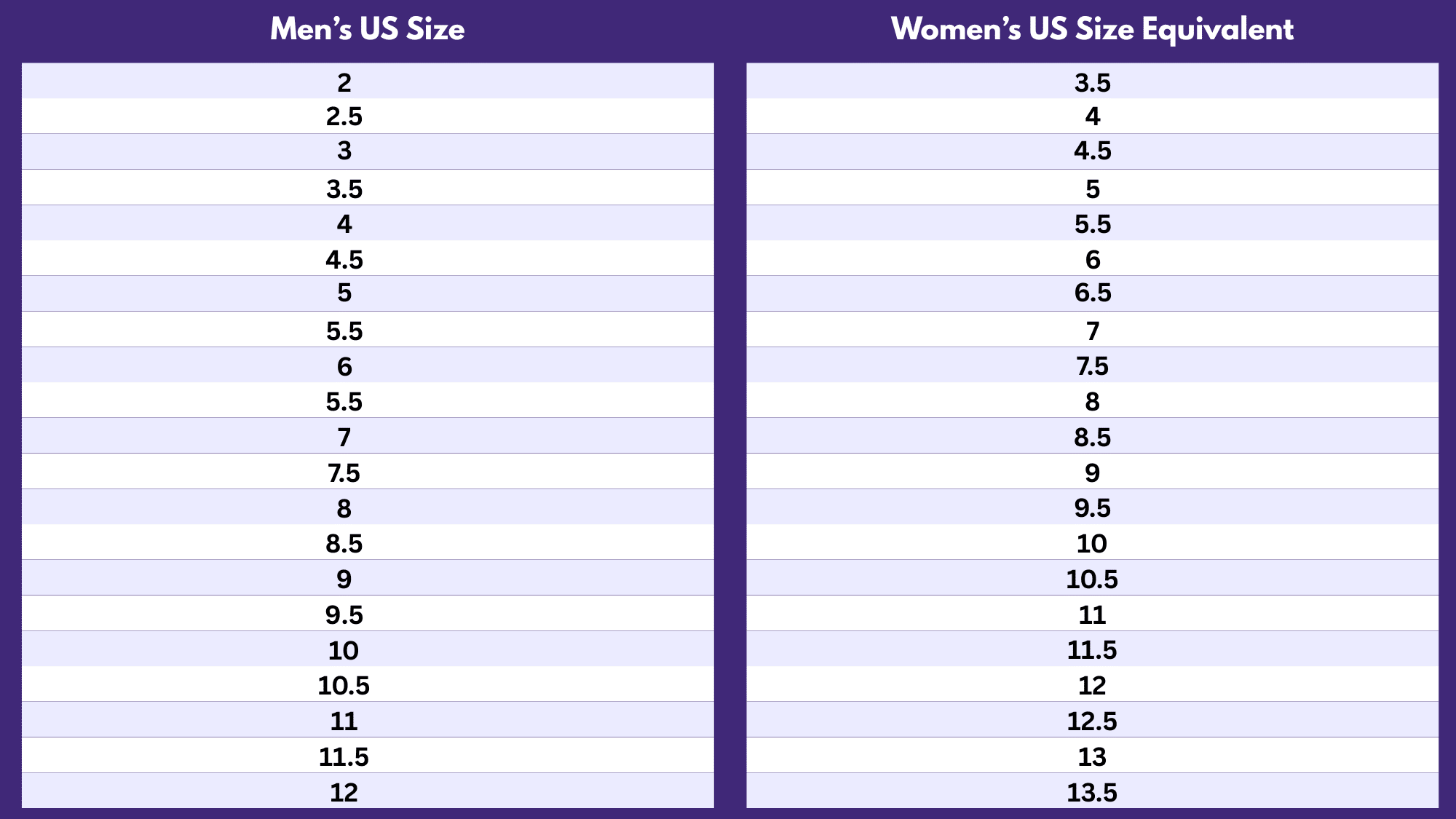
When converting men’s shoe sizes to women’s, the standard rule is to add 1.5 sizes, so a man’s size 8 would typically equal a woman’s size 9.5.
This general rule helps when browsing across genders, but keep in mind that brand variations can affect the fit.
However, some popular brands adjust differently:
- Adidas runs slightly smaller (+1 = women’s 8.0)
- Converse runs bigger (+2 = women’s 9.0)
- Nike, Vans, and Jordan stick to the standard (+1.5 = women’s 8.5)
To avoid sizing surprises, rely on each brand’s different sizing guide before finalizing your purchase.
The chart above covers men’s US sizes 2 through 12 to help you find the best women’s size match more accurately.
Measuring Your Feet to Cross‑Check
Measuring your feet at home is a quick and reliable way to ensure the best shoe fit when converting between men’s and women’s sizes or shopping across different brands and countries.
How to Measure Your Feet at Home:
What You Need: A piece of paper, a pen or pencil, and a ruler.
When to Measure: Do it at the end of the day, when your feet are slightly swollen for the most accurate size.
How to Measure:
- Stand on the paper with your foot flat.
- Trace around your foot.
- Measure the length (from heel to longest toe) and width (across the widest part of your foot).
Convert Inches to US Shoe Size:
Women’s formula: (3 × length in inches) – 21
Men’s formula: (3 × length in inches) – 22
Example: 9.5-inch foot
- Women’s size = 7.5
- Men’s size = 6.5
Foot measurements act as a baseline, helping tailor your choice to individual brand and fit variations.
Taking just a few minutes to measure can save you from discomfort or unnecessary returns.
Brand Variations and Fit Tips
Shoe sizes can vary between brands, even if you follow the correct conversion formula. Always check the brand’s specific size chart before buying, especially when switching between men’s and women’s sizes.
Keep in mind that women’s shoes are usually one width size narrower than men’s.
For example, a man’s D width often equals a woman’s B or C width.
Also consider your foot shape, sock thickness, and style differences.
If you are between sizes or switching from sneakers to boots, you might need to go up or down a half-size for the best fit.
Step‑by‑Step Conversion Workflow
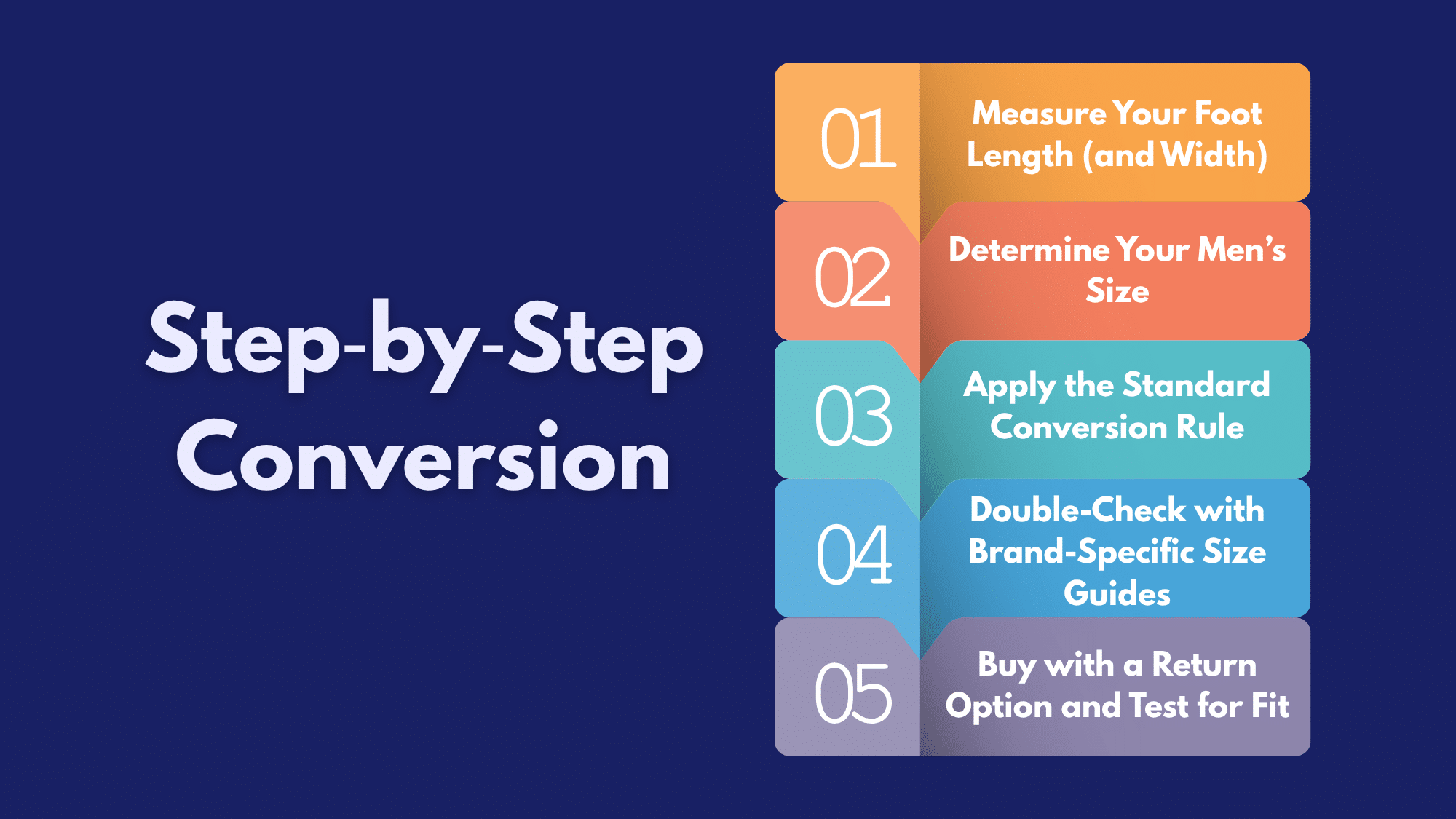
Switching between women’s and men’s shoe sizes is easy if you follow these simple steps. Here is a clear, step-by-step workflow to help you get the best fit every time:
1. Measure Your Foot Length (and Width):
Trace your foot on a piece of paper and use a ruler to measure both length and width in inches or centimeters.
For detailed instructions, refer to the measuring guide above. Accurate foot measurements are key to avoiding sizing mistakes.
2. Determine Your Men’s Size:
Use your foot length to find your current men’s US shoe size from a reliable sizing chart.
Make sure you select the correct sizing system (US, UK, EU) to avoid confusion. Double-check if you are between sizes or have wide/narrow feet.
3. Apply the Standard Conversion Rule:
To convert to women’s sizes, add 1.5 to your men’s size. For example, men’s 7 equals women’s 8.5.
However, brands like Adidas (add 1) and Converse (add 2) vary. Refer to the brand-specific chart provided earlier for a more accurate match.
4. Double-Check with Brand-Specific Size Guides:
Even with general rules, sizing may differ across brands. Visit the brand’s official website and consult their women’s size chart.
Materials, shoe design, and fit preference can all influence the best choice, especially for athletic or fashion footwear.
5. Buy with a Return Option and Test for Fit:
Purchase from retailers with flexible return or exchange policies. When your shoes arrive, try them indoors with the type of socks you usually wear.
Walk around to ensure they’re comfortable and supportive before committing to keeping them.
Final Thoughts
Finding the right shoe size does not have to be confusing. With a little attention to detail, you can confidently shop across men’s and women’s categories.
Size charts are helpful, but your comfort is the best guide. Do not hesitate to size up or down if it feels better.
If you found this helpful, consider printing or saving a size conversion chart for quick reference. You can also share your experience with specific brands to help others find their perfect fit too.
Happy shoe shopping!