

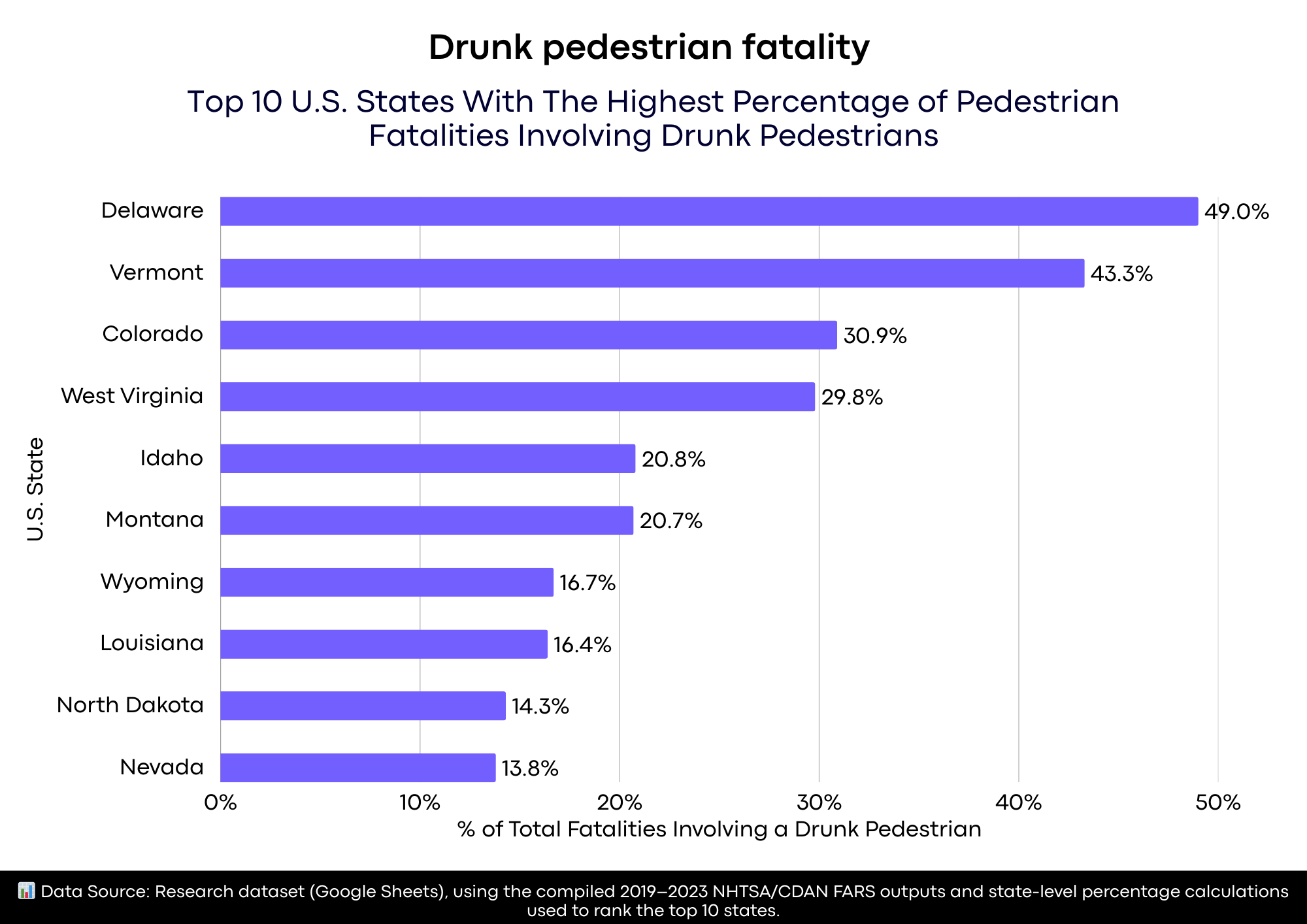
Pedestrian safety across the United States is under renewed scrutiny as a new study exposes the states where walking while intoxicated poses the greatest risk of death. The findings reveal stark disparities in fatality patterns, highlighting specific regions where impaired judgment, limited infrastructure, and nighttime traffic conditions combine to create deadly environments for vulnerable pedestrians.
The research by Florida-based personal injury lawyers Anidjar & Levine analyzed pedestrian fatality data between 2019 and 2023, sourced from the National Highway and Traffic Safety Authority (NHTSA) database. The percentages of total fatalities involving drunk pedestrians were calculated to identify the top 10 states with the most dangerous conditions for intoxicated pedestrians.
|
Top 10 U.S. States With The Highest Percentage of Pedestrian Fatalities Involving Drunk Pedestrians |
||
|---|---|---|
|
U.S. State |
% of Total Fatalities Involving a Drunk Pedestrian |
Rank |
|
Delaware |
49.0% |
1 |
|
Vermont |
43.3% |
2 |
|
Colorado |
30.9% |
3 |
|
West Virginia |
29.8% |
4 |
|
Idaho |
20.8% |
5 |
|
Montana |
20.7% |
6 |
|
Wyoming |
16.7% |
7 |
|
Louisiana |
16.4% |
8 |
|
North Dakota |
14.3% |
9 |
|
Nevada |
13.8% |
10 |
Colorado comes in third with 30.9% of pedestrian fatalities involving a drunk pedestrian. The Centennial State averaged 103 annual pedestrian fatalities during the 2019-2023 period. Colorado recorded 38 drunk pedestrian fatalities in 2020, among the highest in its five-year period, and its lowest count of 25 in 2023.
Looking at the study, a spokesperson at Anidjar & Levine commented,
“The data reveals that Colorado reported some of the highest percentages of pedestrian fatalities involving drunk pedestrians in the U.S.
“Walking while intoxicated during late-night hours often results from factors such as impaired judgment, reduced visibility, lack of pedestrian infrastructure, and higher vehicle speeds. These statistics underscore the critical need for heightened awareness and preventive measures to protect vulnerable pedestrians.
“While pedestrian safety is a persistent concern, communities are advised to take precautions such as using rideshare services or designated drivers, walking in well-lit areas with sidewalks, wearing reflective clothing at night, and avoiding walking near high-speed roadways while impaired. Public awareness campaigns and increased enforcement of pedestrian safety laws are essential to reducing these tragic deaths and protecting our communities.”
What Pedestrians, Communities, and Policymakers Should Know About Drunk Walking Risks
Here’s your strategic roadmap:
Personal Safety and Transportation Decision-Making Strategies
- Use rideshare services, taxis, or designated drivers instead of walking home after consuming alcohol, particularly during late-night hours
- Plan alternative transportation before going out to bars, restaurants, or social events where alcohol consumption is anticipated
- Walk in groups rather than alone when intoxicated, and stay in well-lit areas with sidewalks and pedestrian infrastructure
- Wear reflective or bright-colored clothing when walking at night to increase visibility to drivers, especially in areas without street lighting
- Avoid walking along or crossing high-speed roadways, highways, or roads without sidewalks when impaired by alcohol
Understanding Drunk Pedestrian Fatality Risk Factors
- Recognize that alcohol impairs judgment, reaction time, depth perception, and decision-making abilities that are critical for safe street crossing
- Understand that states with high drunk pedestrian fatality percentages often have limited public transportation, sparse rideshare availability, and car-dependent infrastructure
- Be aware that most drunk pedestrian fatalities occur during late-night and early-morning hours when visibility is reduced and traffic speeds are higher
- Know that rural and small-town environments often lack sidewalks, crosswalks, and pedestrian lighting that could prevent impaired-walking deaths
- Accept that walking while intoxicated dramatically increases the risk of being struck by vehicles, particularly on roads designed primarily for automobile traffic
Advocating for Community-Level Safety Improvements
- Support expanded late-night public transportation services and subsidized rideshare programs in areas with active nightlife districts
- Push for improved pedestrian infrastructure, including sidewalks, crosswalks, pedestrian signals, and street lighting in entertainment and downtown areas
- Advocate for public awareness campaigns specifically targeting the dangers of walking while intoxicated and promoting alternative transportation
Methodology
The study was conducted by Anidjar & Levine, an experienced personal injury law firm dedicated to personal injury cases, including serious injuries and wrongful death, and committed to protecting clients’ rights and maximizing claim value.
The research analyzed pedestrian fatality data between 2019 and 2023, sourced from the National Highway and Traffic Safety Administration (NHTSA) database. The percentages of total fatalities involving drunk pedestrians were calculated to identify the top 10 states with the most dangerous conditions for intoxicated pedestrians.
Data Sources
- CDAN Query → https://cdan.dot.gov/query
- Research Dataset → https://docs.google.com/spreadsheets/d/11adVKSz3YXqhPW2N68c6CPjXUWxaNwct3YLefd4klaA/edit?gid=0#gid=0
- Study by → https://www.anidjarlevine.com/