
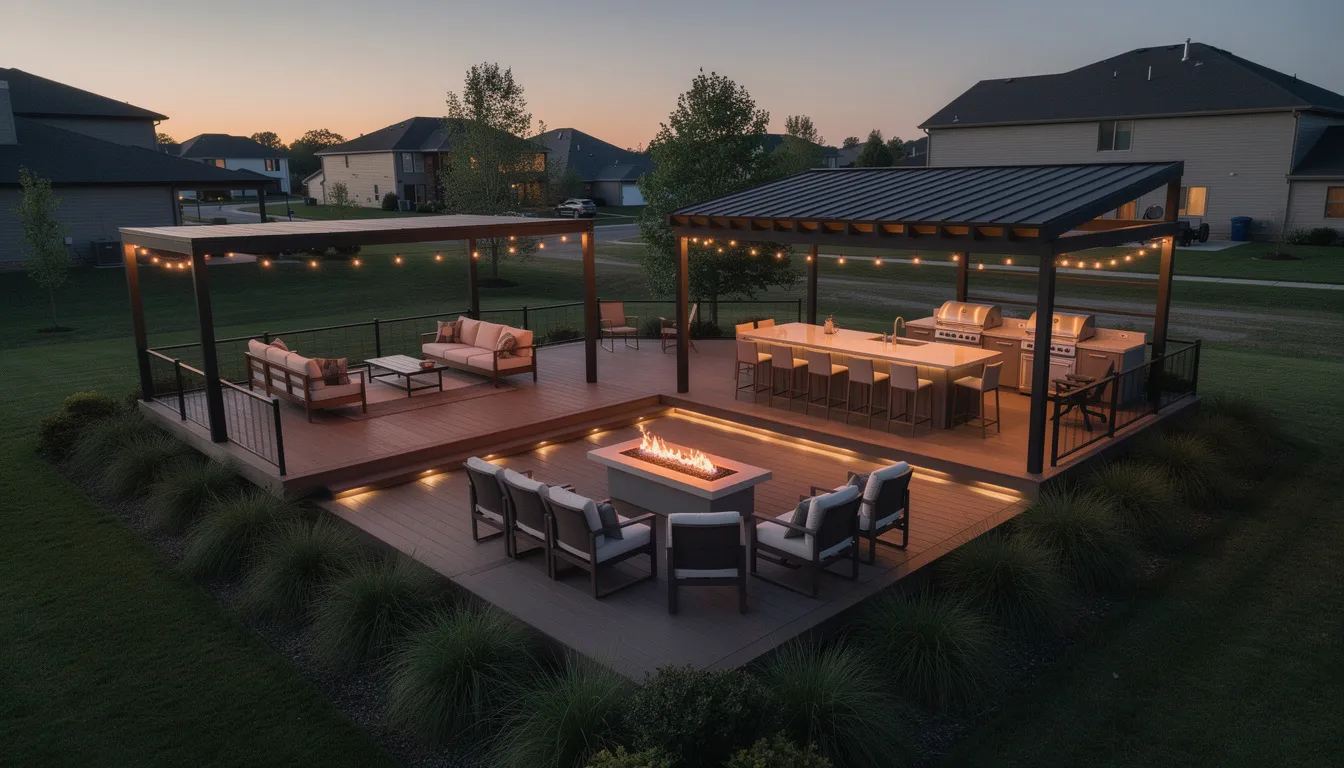

Micro-resort living started quietly. No press releases, no viral TikToks. Homeowners just stopped asking contractors for “a deck” and started describing something closer to a private hotel courtyard. The shift picked up speed around 2022, when a one-week family vacation hit $4,000 to $8,000 after flights, hotels, and food.
For a lot of families, that math stopped making sense. Pacific Northwest builders like Olympic Decks noticed the change early. Clients walked in with mood boards pulled from boutique resort websites, asking for outdoor kitchens, fire features, and covered lounges instead of a basic 12-by-12 platform. The backyard stopped being leftover space. It became the destination.
What Counts as a Micro-Resort?
A patio upgrade is throwing down some pavers and dragging out a gas grill. Micro-resort living is different. It means designing your backyard as a collection of outdoor rooms, each one built for a specific purpose.
Picture a 16-by-20 composite deck. One side holds a grill station and bar counter. The center has a gas fire table surrounded by low seating. The far end sits under a pergola with a dining setup. Each zone connects to the next, and each one has a reason to exist.
Hospitality designers call this circulation and focal points. Hotels spend real money studying how guests move through a space and where their eyes land first. Homeowners are borrowing those same principles. Layered lighting that draws you toward the fire feature. A water wall that catches your attention before you even sit down. Sightlines that make 400 square feet feel twice as large. The difference between a deck and a retreat is intention.
The Economics Behind the Backyard Retreat
Here’s where the numbers get interesting. That $4,000 to $8,000 vacation? That’s one week. Then you’re back to normal until you save up for the next trip.
A resort-style deck project with quality composite materials and a pergola runs $15,000 to $30,000. A full backyard build with an outdoor kitchen, fire features, lighting, and landscaping can reach $50,000 to $80,000. Sounds steep until you realize you can use it every single day. Morning coffee on Tuesday. Friday dinner with neighbors. Sunday afternoon reading under cover while it rains.
Resale numbers back it up too. Industry data consistently shows that well-built outdoor living spaces return 60% to 80% of their cost at resale. Composite builds with covered structures tend to perform even better because buyers see low future maintenance.
Remote work rewired the equation completely. The backyard became a third space. Not home, not office. Something in between that actually makes the day feel different.
Climate Control Changes Everything
A deck you can only use three months a year isn’t a retreat. It’s a seasonal accessory. The whole point of micro-resort living is building space that works eight or nine months out of twelve.
That’s where adjustable louvered roof systems solve the biggest problem. These aluminum slats rotate from fully open to fully closed, giving homeowners real control over sunlight, airflow, and rain. Seattle logs around 152 rainy days a year. A fixed roof or open sky doesn’t cut it. Adjustable control does.
Other elements stack on top of that. Infrared heaters keep shoulder seasons comfortable. Built-in gas fire tables push usability into October and November. Tempered glass wind screens block gusts without killing the view. You can pair a louvered roof over the dining area with open sky above the fire pit. Options instead of compromises.
Climate control turns unpredictable weather from a dealbreaker into a design feature.
Materials That Don’t Ask for Weekends Off
Pressure-treated lumber looks fine the first year. Then the maintenance clock starts ticking. Staining every two or three years. Sanding splinters. Replacing boards that warped over winter. Your weekends disappear into upkeep.
Composite decking from brands like Trex, Azek, and TimberTech resists moisture, fading, and insects without annual work. A soap-and-water wash handles most dirt. No sealing. No sanding. No spring board replacements. Composites absorb less than half a percent of water compared to wood’s 10% to 20%. In humid climates, that gap matters.
You’re building a retreat, not a maintenance schedule. Low-upkeep materials make that possible.
Privacy Engineering Without the Fortress Look
Your neighbor has second-story windows aimed right at your fire pit. Dogs bark three houses down. That resort feeling disappears fast when you feel like you’re sitting on a stage.
Visual screening starts with layers. Staggered composite privacy panels, lattice frames with climbing vines, and plantings at different heights. Ornamental grasses up front, taller shrubs behind, a small tree anchoring the corner. You build a sense of room without a six-foot blank wall that screams “keep out.”
Sound matters just as much. Water walls and bubbler fountains generate 30 to 50 decibels of white noise. Enough to soften neighbor conversations and street traffic without sounding like Niagara Falls. Planted berms absorb sound in ways hard surfaces never will.
Lighting pulls it all together. Warm, low fixtures on steps and seating areas. Softer glow along fence lines. Skip the bright floodlights. The goal is intimacy, not a stadium. A typical lot can feel genuinely private with the right combination of screens, sound, and light.
Conclusion
Micro-resort living isn’t about luxury for its own sake. It’s a practical response to how people actually spend their time now. Comfort you reach by walking outside, not boarding a flight. Materials that hold up without stealing your weekends. Space designed with the same care a hotel gives its courtyard.
As outdoor technology improves and materials get smarter, the gap between “backyard” and “retreat” keeps closing. Homeowners willing to plan with intent are already living what used to require a reservation.
Frequently Asked Questions
What is micro-resort living?
Micro-resort living is a design approach where homeowners build their backyards as multi-zone outdoor retreats. Instead of a single-purpose patio, the space is divided into areas for cooking, dining, lounging, and relaxing, borrowing layout principles from boutique hospitality design.
How much does it cost to build a backyard micro-resort?
A basic multi-zone deck with a pergola typically costs $15,000 to $30,000. Full builds that include outdoor kitchens, fire features, louvered roofs, and landscaping can reach $50,000 to $80,000 depending on materials and scope.
What materials work best for a micro-resort build?
Composite decking from manufacturers like Trex, Azek, and TimberTech is the most common choice. These products resist moisture, fading, and insects without requiring annual staining or sealing. Aluminum-frame pergolas and louvered roofs are popular for overhead structures.
Can you build a micro-resort in a rainy climate?
Yes. Adjustable louvered roofs, composite decking rated for moisture exposure, infrared heaters, and tempered glass wind screens make year-round outdoor living practical even in regions with 150 or more rainy days per year.
Is micro-resort living practical for small backyards?
Yes. Many successful designs work on compact lots by using vertical layering, multi-purpose built-in furniture, and smart zoning. A 300-square-foot deck can feel like a private retreat with the right overhead cover, layout, and lighting plan.
How long does a backyard micro-resort project take to complete?
Most projects run 3 to 8 weeks. Simpler deck-and-pergola builds can wrap up in under a month. Full builds with outdoor kitchens, electrical work, plumbing, and landscaping may take two months or slightly longer.